
The placebo effect: when your brain becomes its own doctor
4 min read
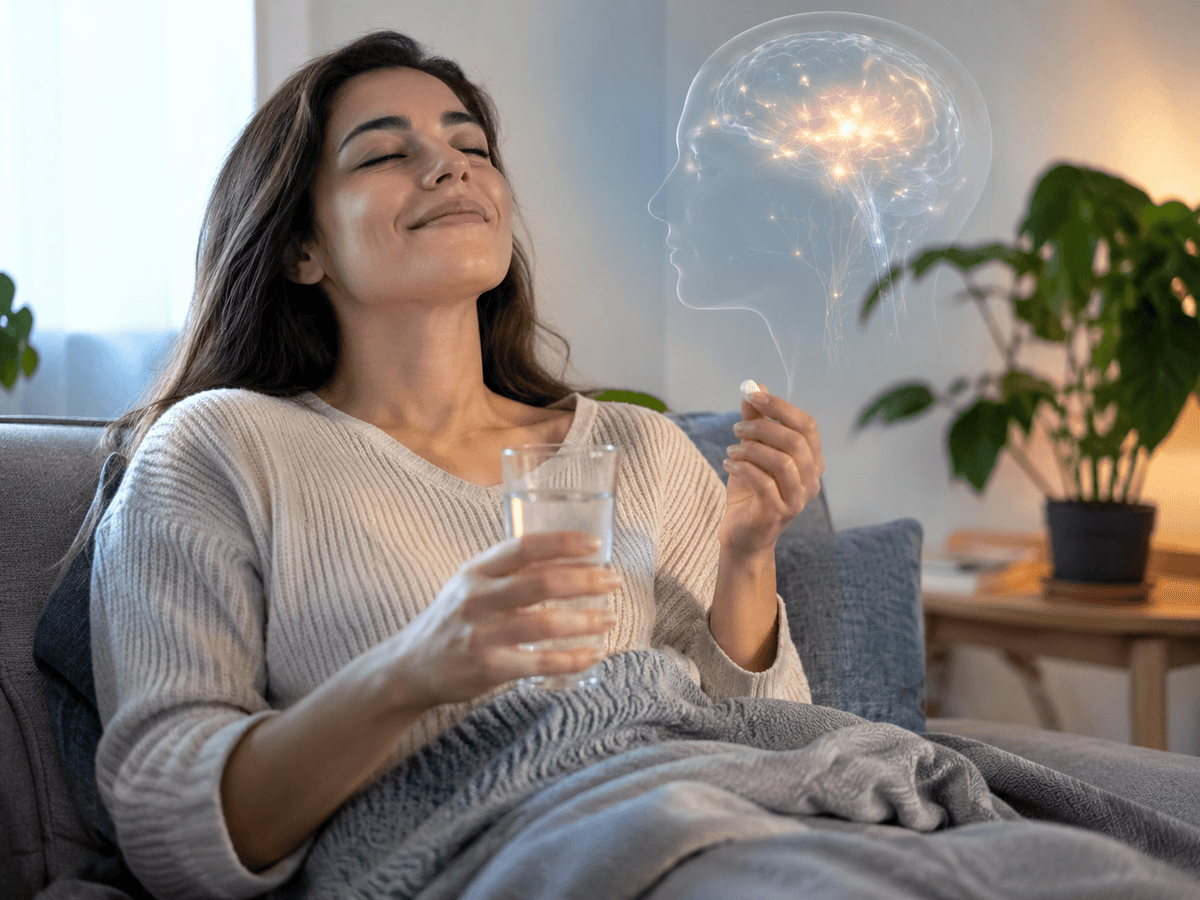
You swallow a sugar pill and your pain eases, gradually, as if by magic. Well, it isn’t really magic, since there’s a scientific explanation for all of this. Your body literally produced the molecules that made you feel better after that pill. That’s the placebo effect. Reducing it to gullibility is missing something far stranger and far more powerful.
What “placebo” means, first of all
The word comes from Latin: placebo, “I shall please.” It first appears in a religious context, in the Middle Ages, to describe prayers recited without conviction. It was only in the 18th century that it slid into medicine, to describe a treatment given “to please” the patient rather than to really treat them.
Today, a placebo refers to any intervention (pill, injection, simulated surgery) that contains no active ingredient meant to act on the targeted illness. And the placebo effect is the real, measurable response the body produces anyway, or rather: because of it.
The distinction matters. The placebo is the tool. The placebo effect is what happens in the body.
What really happens in your brain (and elsewhere)
When you believe a treatment will work, your brain doesn’t stay neutral. It acts.
Medical imaging studies have shown that taking a placebo for pain activates the same brain areas as a real painkiller. Better still: the body releases endorphins in response to the placebo. How do we know? By giving naloxone, an opioid blocker. Result: the placebo effect disappears. It isn’t imagination, it’s chemistry.
The phenomenon isn’t limited to pain. Effects have been measured on blood pressure, immune response, Parkinson’s symptoms (where dopamine production genuinely increases) and even anxiety. Every time, it’s the body doing the work and the brain just has to give the go-ahead.
The most counterintuitive fact: it works even when you know it’s a placebo
Here it gets truly weird…
Harvard researchers, around 2010, ran an experiment with patients suffering from irritable bowel syndrome. They gave them pills clearly labeled “placebo,” so: no deception, no ambiguity. And it still worked significantly better than giving nothing at all.
This is called “open-label placebo,” the placebo out in the open. The strongest hypothesis to explain the result: the very fact of engaging in a care ritual (taking something at a set time, focusing on your health) is enough to activate part of the response. The brain doesn’t need to be tricked. It needs a context.
This challenges the idea we often have of medicine: a treatment’s effectiveness is never purely chemical. The context, the relationship with the doctor, the ritual of taking it, ALL of that is part of the care.
The nocebo effect: the dark side of the coin
The placebo effect has an evil twin: the nocebo effect (from Latin “I shall harm”).
If you believe a treatment will hurt you, it can actually hurt you even if it’s inert. Patients taking placebos in clinical trials regularly report side effects: headaches, nausea, fatigue. Their body responds to the negative expectation with the same fidelity it responds to the positive one.
That’s one reason a medication leaflet is, in a sense, a document to handle with care. Reading the list of side effects means exposing yourself to a suggestion, and some of those effects may appear not because of the molecule, but because of knowing about them.
Why it’s central to medicine (and not just anecdotal)
Every drug has to prove it does better than a placebo to be approved. That’s the basis of double-blind clinical trials: neither the patient nor the doctor knows who receives the real treatment, precisely to neutralize the placebo effect and measure only the action of the molecule.
But here’s what we understand better and better: the placebo effect isn’t a parasite to be eliminated. It’s an active component of every treatment. When your doctor prescribes an effective drug, you benefit from both its pharmacological action AND the placebo effect. The two add up.
Which partly explains why the same drug can work differently depending on whether your doctor explains what they’re doing or just hands you the prescription in silence.
In short
The placebo effect isn’t a story about gullible people getting fooled. It’s a real neurobiological mechanism, involving hormones, neurotransmitters and well-documented brain circuits. It works even without deception. It has an equally real negative counterpart. And it reminds us of something medicine sometimes tends to forget: healing also means creating the conditions in which the body can activate its own resources.
Mini quiz
What does the brain release under a placebo effect against pain?
What is the harmful effect produced by a negative expectation toward an inert treatment called?
Open-label placebos have shown that the placebo effect…
Keep reading on GenK
Why sleep is essential for memory consolidation
How chronic stress actually affects the body
What is neuroplasticity, and can you really “rewire” your brain?
🧠 Your brain can do even more than you think
What the placebo effect reveals is that the boundary between “mental” and “physical” is far more porous than we imagine, and that understanding this really changes how we see health. On GenK, we dig into this kind of question every day in a few minutes, with formats designed to stay in your head.
Download GenK for free