
Why did the Roman Empire fall?
4 min read
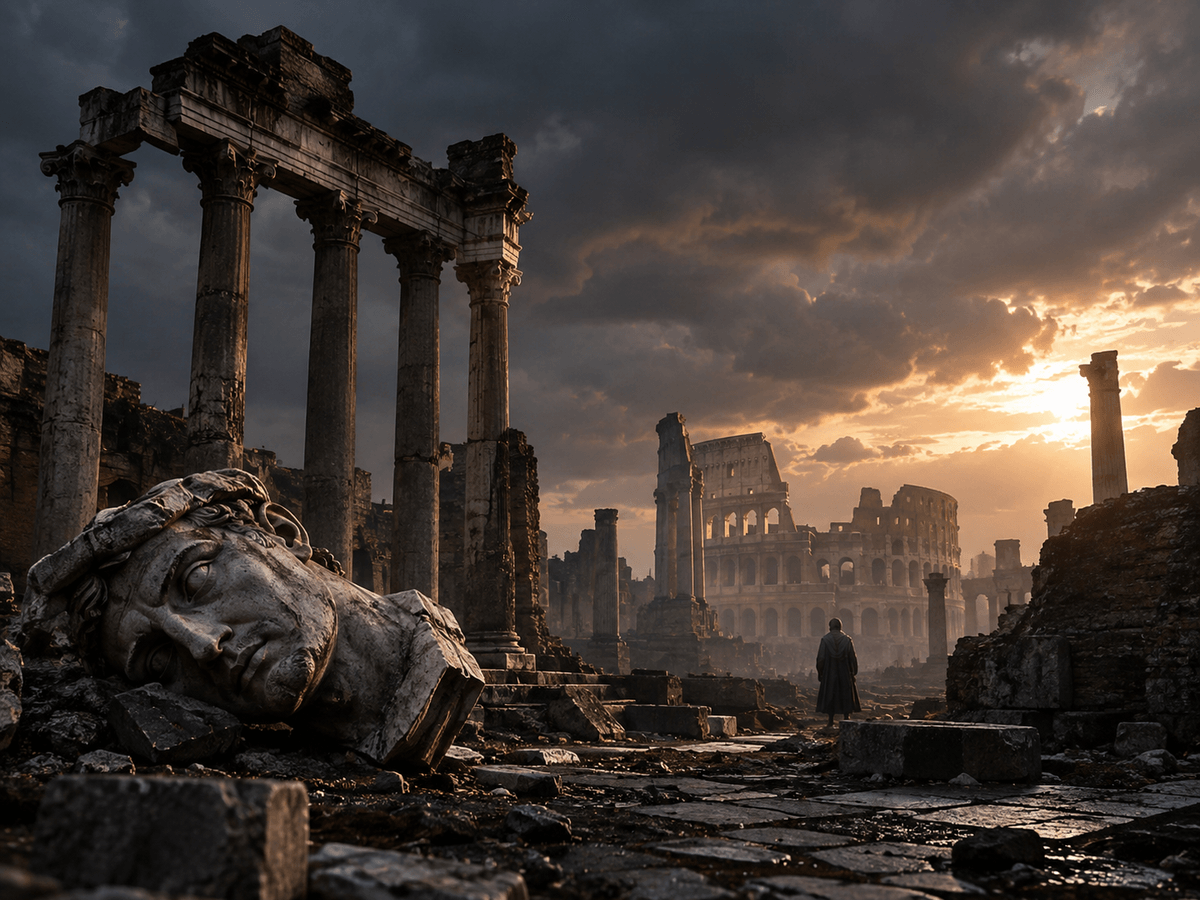
Rome didn’t vanish one evening in AD 476 because some barbarian toppled the wrong emperor at the wrong moment. It’s one of the most debated questions in history — historians have devoted their entire lives to it, and they still don’t all agree. What we do know is that the short answer (“the Barbarians”) is about as adequate as saying the Titanic sank because of water.
First: which “fall” are we talking about?
Before explaining why Rome fell, we need to agree on what we mean by that. The Western Roman Empire officially ends in 476, when the Germanic chieftain Odoacer deposes Romulus Augustulus, the last emperor in name. A handy date for school textbooks. But frankly, people at the time barely noticed this “tipping point” — the empire had been coming apart for decades, and the Eastern Roman Empire (later called Byzantium) carried on until 1453. Yes, a thousand years longer.
So when we talk about the “fall of Rome,” we’re mostly talking about the gradual collapse of a political and military structure in the West, between roughly the 3rd and 5th centuries. Not a thunderclap, but a slow disintegration.
The main causes: what historians actually take away
The 3rd-century crisis: the first big blow
Between AD 235 and 284, the empire goes through an almost uninterrupted period of chaos. In fifty years, around twenty emperors come and go — most of them murdered by their own soldiers. The legions become the real kingmakers, every ambitious general tries his luck, and the empire temporarily splits into three rival entities.
It’s not the end yet, but the machine is grinding. Trade routes deteriorate, inflation explodes (Egyptian papyri show that some prices were multiplied by 50 over a century), and trust in institutions erodes. Rome recovers from this crisis thanks to Diocletian and Constantine, but it never quite regains its earlier stability.
Pressure on the borders: an empire too big for itself
An empire stretching from Scotland to Mesopotamia is expensive to defend. From the 4th century on, pressure on the borders intensifies from every side: the Huns, coming from the steppes of Central Asia, push Germanic peoples (Visigoths, Ostrogoths, Vandals) ahead of them, and these peoples want to settle inside the empire — sometimes by asking politely, sometimes not.
Rome increasingly brings “barbarian” soldiers into its armies, even whole generals. That isn’t a weakness in itself — the empire had always been multicultural. But when bonds of loyalty to Rome fade in favor of the interests of particular clans or peoples, the model cracks. The sack of Rome by Alaric’s Visigoths in 410 is an enormous psychological shock for people at the time. Saint Augustine writes The City of God partly in reaction to it.
Splitting the empire: a good idea with bad consequences
Diocletian, at the end of the 3rd century, splits the empire’s administration in two to make it easier to govern. On paper, it’s pragmatic. In practice, it gradually creates two entities with diverging interests. The East, richer and more urbanized, invests in its own defense and slowly leaves the West to fend for itself. Imperial solidarity thins out.
The economy goes off the rails
Permanent war is expensive. To pay for the legions, emperors debase the currency (by reducing the amount of silver in coins), which generates inflation. Trade contracts. Large estates (the latifundia) swallow up ruined small farmers, who become tenants tied to the land — a foreshadowing of medieval serfdom. The empire loses its middle class, if you can put it that way.
And what about religion?
Edward Gibbon, an 18th-century British historian, had a famous thesis: Christianity weakened Rome by steering elites away from martial values toward spiritual ones. That reading is largely disputed today — modern historians find it too simple, even biased. What is true is that internal theological conflicts (heresies, quarrels between bishops) sometimes drained political energy. But blaming the fall of Rome on Christianity alone ignores the decades of structural crisis that came before.
So, what’s the real answer?
There isn’t just one. What makes the question interesting is precisely that it resists simple explanations. The American historian Bryan Ward-Perkins, in The Fall of Rome and the End of Civilization (2005), insists on the reality of material decline: fewer pottery finds, fewer buildings, fewer traces of literacy in the centuries after 476. That’s a real regression, not just a transformation. Conversely, Peter Heather emphasizes external pressure as the trigger. Others, like Walter Goffart, prefer to speak of a gradual “accommodation” rather than a fall.
This debate isn’t only academic. It touches on a question we still ask today: how do great powers collapse? From blows from outside, or from fractures within? Probably both, and probably not in the order we think.
Mini quiz
In what year does the Western Roman Empire officially end?
Which nomadic people from Central Asia set off the great Germanic migrations toward the Roman Empire?
What does the “3rd-century crisis” mean for the Roman Empire?
Keep reading on GenK
How the Byzantine Empire survived a thousand years after the fall of Rome
The great invasions: who were the “barbarian” peoples really?
Decline or transformation? What Late Antiquity teaches us about the end of civilizations
🏛️ Rome fell over several centuries. Learn it in 2 minutes a day.
GenK is the app that turns exactly this kind of question — the ones that deserve a real answer, not a 40-minute Wikipedia article — into short, sourced, addictive formats. More than 200,000 people have downloaded it, and they rate it 4.7 stars.
Download GenK for free