
Are animals aware of themselves?
6 min read
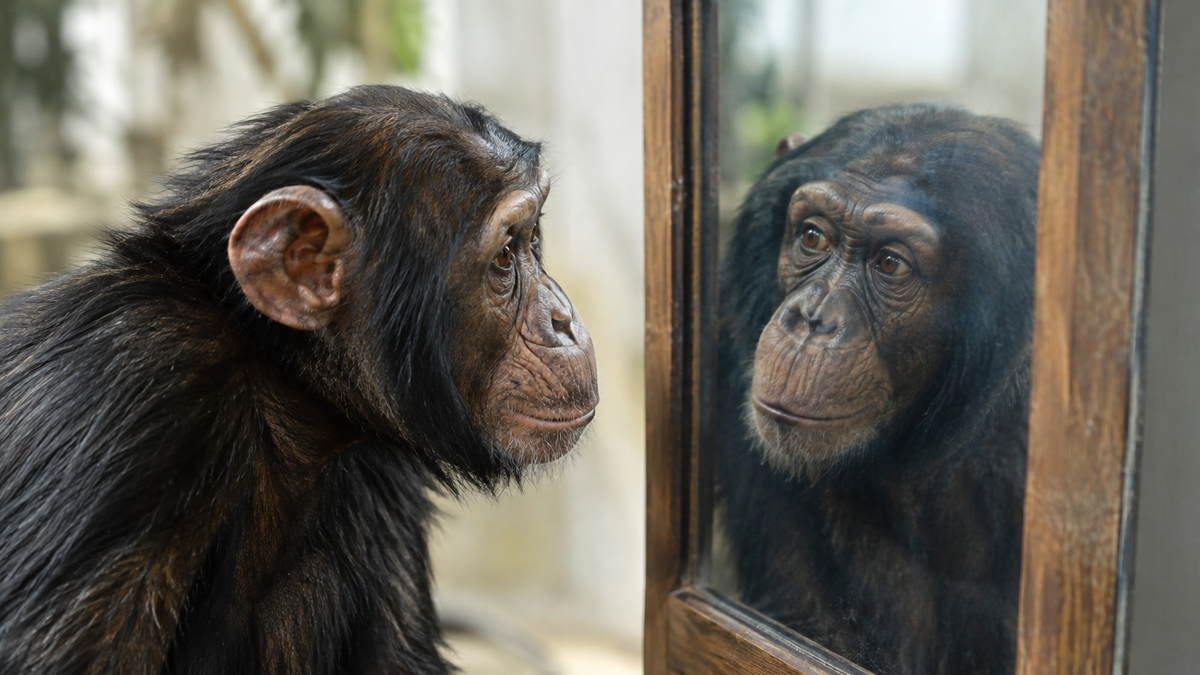
For a long time, the dominant answer was “no, and don’t even ask.” Today, neuroscience and cognitive ethology have shaken everything up. It’s not that we discovered animals “think like us,” it’s far more interesting than that.
The mirror test: a brilliant idea with its limits
In 1970, psychologist Gordon Gallup Jr. had a simple but devilishly clever idea. He anesthetized chimpanzees, painted a colored mark on an eyebrow and an ear, and watched what happened when they woke up in front of a mirror. If the animal touched the mark on its own body while looking at its reflection, it meant it understood that the reflection was itself.
The result: the chimpanzees passed the test. And since then, the list has grown to include orangutans, bonobos, dolphins, elephants and, more surprisingly, magpies. Birds. Not exactly the ones you’d imagine philosophizing about their identity.
But the test has a fundamental problem that’s often downplayed: it relies entirely on vision. Dogs, for example, consistently fail it. Does that mean a dog has no awareness of itself? Not really. Dogs build their representation of the world mainly through smell. When the paradigm is adapted to their dominant sense, by presenting them with their own modified scent, some react in a way that suggests they do have a form of self-representation. The mirror test may therefore measure reliance on vision more than an absence of awareness.
Self-awareness: what are we really talking about?
The real trap of this question is that we ask it as if “self-awareness” were a single, clearly defined thing. In reality, researchers distinguish several levels that are anything but equivalent.
First there’s what’s called bodily self-awareness: knowing where your body is in space, being able to control it, anticipating your own movements. A cat jumping onto a shelf does this constantly, and nearly every animal with a central nervous system has this level.
Next comes self-awareness as an entity distinct from others: understanding that I am “me” and not “you.” This is where the mirror test comes in, and it’s already much more selective.
And then there’s what philosophy calls reflective awareness, or metacognition: the ability to think about your own thoughts, to tell yourself “I don’t know,” to anticipate what others know or don’t know. This is the level that fascinates researchers most right now, and the results are unsettling.
Experiments on macaques and dolphins have shown that they can signal their own uncertainty before answering a task. In other words, they seem able to assess their own state of knowledge. It’s a form of looking at oneself that goes far beyond a simple reflection in a mirror.
Behaviors that raise questions: grief, empathy, deception
It’s often behaviors observed in the wild, not in the lab, that raise the hardest questions.
Elephants spend several hours, sometimes several days, around the body of a dead member of their species. They touch it with their trunks, stay silent, and come back years later to the bones. Do they “know” that this individual is gone? Do they have a representation of death, and therefore, implicitly, of their own finitude? We can’t prove it in the strict sense, but the question is legitimate.
Ravens and western scrub jays practice what’s called deliberate deception: if an individual is seen hiding food, it may come back later to secretly move it. This strategy seems to require modeling what the other saw, what the other knows, and what you want them to believe. It’s a form of theory of mind, the ability to represent another’s mental state, long considered strictly human.
Great apes go even further. In several studies, chimpanzees misled competitors to protect a food stash. They adapted their behavior based on who was watching and what that individual could see. That’s not reflex. That’s strategy.
The counterintuitive part: “simple” animals that pass the tests
We naturally assume that the closer an animal is to us phylogenetically, on the tree of life, the more likely it is to have some form of self-awareness. Great apes first, then mammals, then birds, then... nobody.
Except the data doesn’t confirm this neat, reassuring hierarchy.
Recent experiments on cuttlefish have shown behavior that looks a lot like planning: in a 2021 “marshmallow”-style test, they waited to get their preferred food rather than settling for another one right away. That isn’t self-awareness in the human sense, but it’s a form of self-control, which implies an internal representation of what they want.
Even more unsettling: in 2019, a study showed that a type of cleaner fish, the cleaner wrasse, passed a modified version of the mirror test. A fish.
This result has been disputed, but it illustrates how far the debate can go. Self-awareness may not be a rare property reserved for big, complex brains. It may be an evolutionary solution that emerged several times, independently, in very different lineages.
What it changes: the ethical question in the background
There’s a reason this scientific debate regularly spills onto opinion pages and into legal debates. If an animal has awareness of itself, even minimal, then it probably has some form of subjective experience. It can suffer not only physically, but in its representation of itself. And that changes everything about how we’re entitled to treat it.
In 2012, a group of leading neuroscientists signed the Cambridge Declaration on Consciousness, explicitly stating that mammals, birds and even octopuses possess the neurological substrates that generate consciousness. It’s not an activist text, it’s a collective scientific position.
Since then, several countries have changed their legal frameworks to recognize animal sentience as a legal fact. In France, the Civil Code has recognized since 2015 that animals are “living beings endowed with sentience.” That’s not a philosophical statement. It’s positive law, backed by science.
What we really know, and what we’re still fumbling with
Self-awareness isn’t a switch, on in humans and off in animals. It’s a spectrum, with different levels, different forms, and probably subjective experiences we don’t yet have the tools to measure properly.
What we can say with real confidence: several species have a form of self-representation that goes beyond simple reflex. Some can model the mental states of others, anticipate, deceive, plan. What we don’t know yet, and it’s honest to say so, is what it feels like “from the inside” to be a dolphin recognizing itself in a mirror. The question of subjective experience remains open, and that’s not an admission of weakness: it’s the most honest frontier of contemporary science.
Mini quiz
Which researcher invented the mirror test for animals?
Why do dogs generally fail the mirror test?
What is “metacognition” in animals?
Keep reading on GenK
How do animals communicate with each other? What science has discovered
What is empathy, and do humans really have a monopoly on it?
Animal dreams: romantic myth or neurological reality?
🐬 If you want to go deeper into your own head
Self-awareness is a question we think belongs in philosophy class, and yet it runs through psychology, neuroscience, and even law. GenK digs into exactly this kind of subject: questions that seem simple until you pull the thread.
Download GenK for free